Did Your Doctor Use AI in Med School?
Effects of Disclosed AI Use During Training on Trust in Experts
1Department of Philosophy, University of Missouri, Columbia, MO · 2Department of Mathematics, Saint Louis University High, Saint Louis, MO
falvear@missouri.edu
Background
A growing share of professional competence is now acquired with the help of AI. Medical trainees routinely use AI tools to study, prepare for exams, and build clinical skill.
Prior work asks how patients react to AI used at the point of care (Shaffer et al., 2013; Zondag et al., 2024). We ask a different question: When people learn an expert’s competence was developed with AI assistance (with present credentials held fixed) does that change how much they trust the expert, and why?
We extend Mayer, Davis, & Schoorman’s (1995) ability–benevolence–integrity model of trust with a fourth dimension, autonomy of judgment, to explore how disclosure of AI training affects perceptions of a doctor’s trustworthiness, competence, character, and independence of thought.
Method
Participants (recruited on Prolific) read a vignette about a board-certified physician who recently finished training. Training history was manipulated between subjects; all other credentials were held constant. Participants then rated trust/comfort and, on 7-point agree–disagree items (0 = strongly disagree, 6 = strongly agree), the doctor’s ability, benevolence, integrity, and autonomy, and how likely he is to use AI in his current practice.
| Conditions | DV | N | |
|---|---|---|---|
| S1 | Used AI / Did not use AI / No info (control) | Trust (comfort + confidence) | 216 |
| S2 | Used AI / Did not use AI/ Used peer tutor / Did not use peer tutor / No info (control) | Comfort | 335 |
Composites required Cronbach’s α ≥ .80. Effects were tested with one-way ANOVA + Bonferroni-corrected pairwise contrasts, then parallel mediation (Hayes’ PROCESS, model 4, 10,000 bootstrap samples) with all candidate mediators entered simultaneously.
Study 1 Preregistered
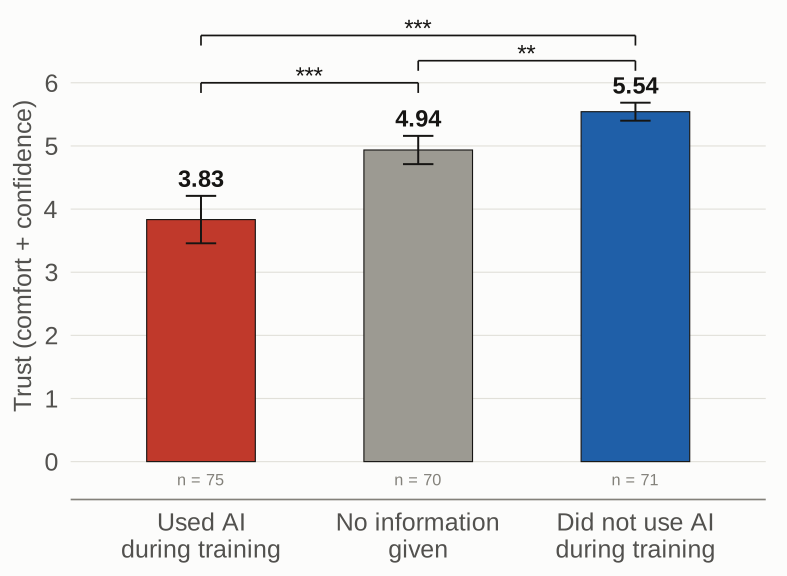
A board-certified cardiologist (“Dr. Smith”) was described as having used AI tools during training, having never used them, or with no information given.
Why? Mediation
With all four trust dimensions entered as parallel mediators, the direct effect of condition became non-significant (p ≥ .08), consistent with full mediation.
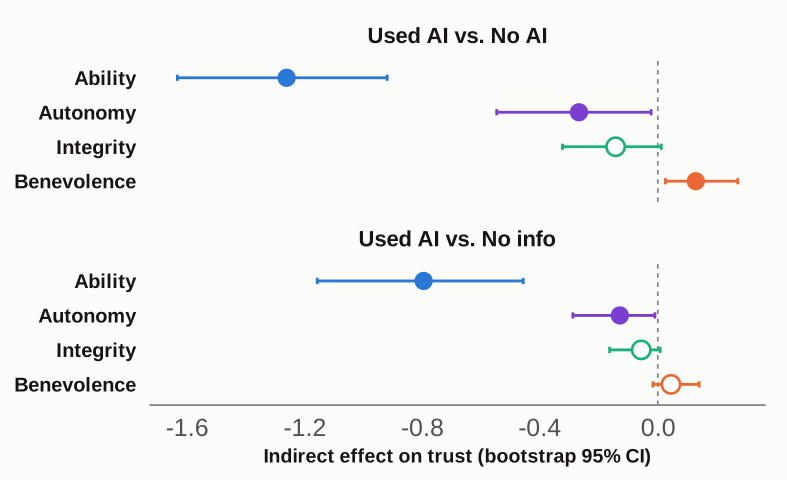
Learning that a doctor trained with AI doesn’t just make him seem less skilled, it makes him seem less likely to think for himself. It does not make him seem less caring or less principled.
Study 2 Preregistered
Are these AI-specific effects, or do they reflect a generic penalty/reward for any disclosed outside help? Study 2 (5 conditions) adds a parallel peer-tutor arm alongside the AI manipulation, sharing one control group.
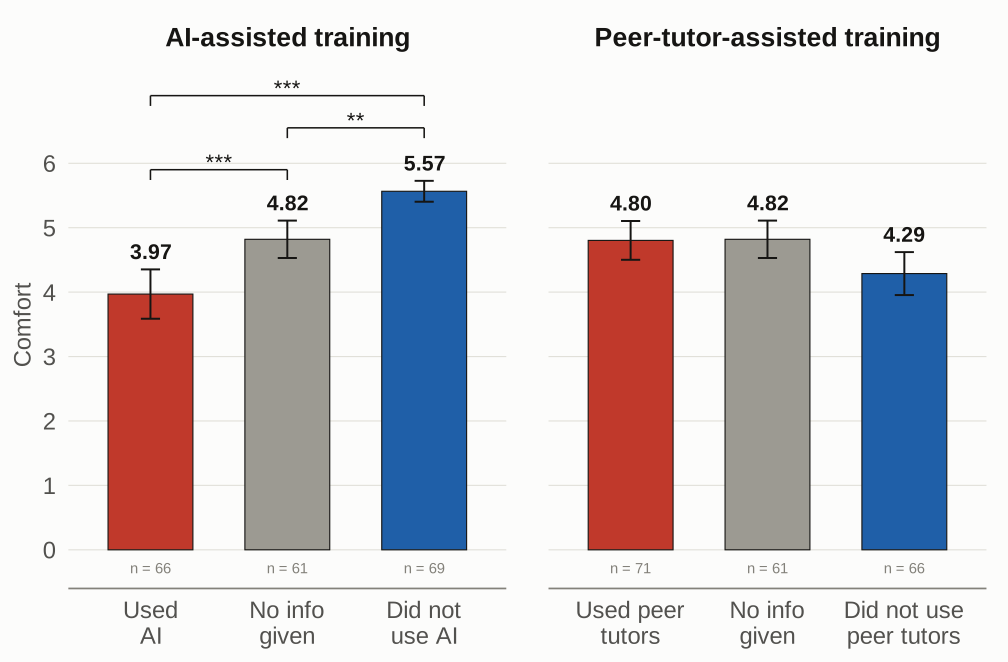
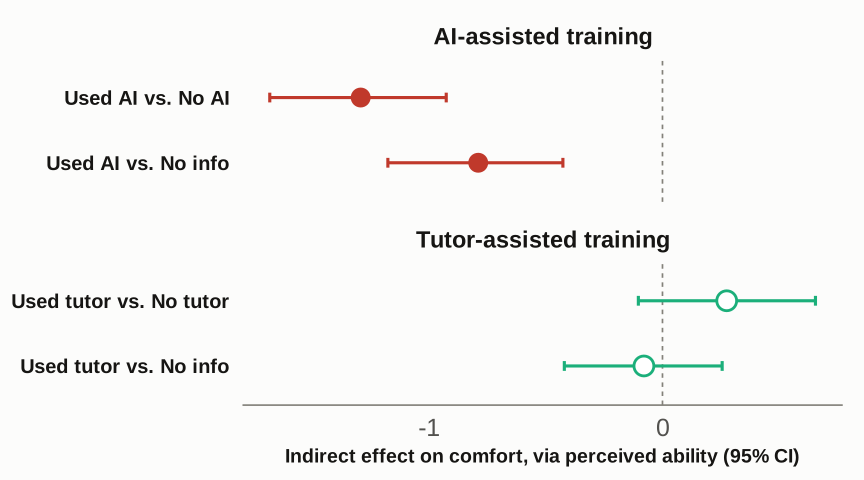
The two-sided AI effect does not generalize to human help: the parallel peer-tutor manipulation produced no reliable effect on comfort in either direction. The penalty comes from AI assistance in particular, not assistance in general (Reif et al., 2025).
Discussion
Across two preregistered studies, disclosure of information about the involvement of AI in a doctor’s medical training moves trust in both directions from a shared no-information baseline: using AI sharply reduces it, and explicitly not using it raises it just as reliably (p = .006). This suggests not only a penalty for AI use, but a reward for not using it. Neither direction reflects doubts about the doctor’s goodwill or integrity; both trace to perceived competence and capacity for independent clinical judgment. Study 2 shows this two-sided pattern is specific to AI: a parallel peer-tutor manipulation had no effect on comfort.
People appear to treat AI-assisted training as compromising the self-authored character of expertise itself — a distinct concern from whether the expert is a good or principled person. This has implications for how AI use during training is (or isn’t) disclosed in medicine and other professions, and for how licensing and educational bodies think about AI-assisted skill acquisition.
Study 1a Preregistered replication
Same 3-condition AI-training manipulation as Study 1, crossed with medical stakes (serious heart condition vs. minor skin issue), N = 335.
- AI-training penalty on trust replicated: F(2, 329) = 17.48, p < .001.
- Stakes did not moderate the effect — interaction p = .52. The penalty for use of AI, and the reward for its non-use, was the same whether treatment was sought for a minor skin problem or a serious heart condition.
References
Mayer, R. C., Davis, J. H., & Schoorman, F. D. (1995). An integrative model of organizational trust. Academy of Management Review, 20(3), 709–734.
Reif, J. A., Larrick, R. P., & Soll, J. B. (2025). Evidence of a social evaluation penalty for using AI. Proceedings of the National Academy of Sciences, 122(19), e2426766122.
Shaffer, V. A., Probst, C. A., Merkle, E. C., Arkes, H. R., & Medow, M. A. (2013). Why do patients derogate physicians who use a computer-based diagnostic support system? Medical Decision Making, 33(1), 108–118.
Zondag, A. G. M., Rozestraten, R., Grimmelikhuijsen, S. G., Jongsma, K. R., van Solinge, W. W., Bots, M. L., Vernooij, R. W. M., & Haitjema, S. (2024). The effect of artificial intelligence on patient–physician trust: Cross-sectional vignette study. Journal of Medical Internet Research, 26, e50853.

Questions, comments?
Scan the QR code. Select any text or tap a figure to leave a note for us. Only you and the authors can see what you write.
line